Hi, my name is Robert Friedrichsen, I have been working in the fluid power industry (Hydraulics & Pneumatics), I am now well into my sixties. I have worked on tools, and in the commercial side and as a fluid power engineer designing systems. For your information I am dual qualified trade and mechanical Engineer Specializing in Fluid Power. I did my apprenticeship and post years as a tool maker and building special purpose machinery for the automotive industry and many materials handling projects. At the age of 25 I developed a passion not to build the machinery but to make it move, the right amount, speed, hold up loads and properly sequenced systems. I am still doing it more than 40 years later. Today I and for the last 30 years I have started, owned and run Statewide Hydraulics and mainly work exclusively with hydraulics.
This business can be divided up into two very broad areas.
- Servicing , trouble shooting , repairs, and maintenance
- New systems, design, and part supply.
Today we are going to talk about maintenance, servicing and repairs. The maintenance starts well before your hydraulic repairer gets on site.
IT starts with YOU.!
Choose the right person to do your job! Do your diligence.
Take a breath gather your thoughts, don’t panic!
Are you going to ring your mate because he had a hydraulic machine once.
Are you going to ring the guy who fixes your hoses.
Are you going to ring the last guy that worked on your machine that you weren’t happy with
Are you going to get onto google and ring the top 5 choice because they should know what they are doing.
Or Are you going to ring me because my web site looks good. I hope so.
Are you going to ring the bloke around the corner because he is the closest and can get here quick.
Take your time and spend 30 or 60 minutes. It could be the best 30 to 60 minutes you spend in the next few hours or days.
Consider what your problem really is and what the real costs are.
- Your machinery has stopped, this may result in many different scenarios. All, I have been involved with with my clients over the years.
- Road closures in peak hours
- Cranes stop working when loads hanging on them precariously
- Food spoilage, one of the worst was a B double full of chocolate, a lot of kids did not get any Easter eggs.
- Concrete setting before you finish the job is always a problem.
- Lost production in manufacturing plants.
You need to choose the right person first time. Hope this helps you when you next have a problem. Unfortunately, there are a lto of people out there who claim to be all sorts of hydraulic experts. The worst, “Hydraulic Hose Doctors”. These guys get 3 weeks training, a van, a phone and an invoice book and they are a Doctor of what. We refer to them as hose w*****s. Take a breath again, in what industry or profession any where in the world do you get the title of Doctor with 3 weeks training. Commercial mumbo jumbo. Even your father would have taught if it sounds like mambo jumbo , it probably is.
Choosing the right person.
Why the Technician You Pick Matters More Than You Think
Hydraulic systems are the beating heart of countless machines across construction, manufacturing, transport, agriculture, waste management, and mining. When they fail, they don’t just stop a machine — they stop productivity, revenue, and sometimes entire operations. Yet despite how critical hydraulics are, many businesses still underestimate the importance of choosing the right person to diagnose and repair their system.
Nto all hydraulic workers are created equal. In fact, the industry is full of different tiers of capability, training, and experience — from basic hose repairers to fully qualified hydraulic technicians with trade backgrounds and additional specialized training and diagnostic equipment. Understanding these differences is essential if you want your system repaired properly, safely, and without repeat breakdowns.
This article breaks down the types of hydraulic failures, the types of workers you’ll encounter, and why a true hydraulic technician is the only person you should trust with complex troubleshooting.
Different Types of Hydraulic Breakdowns
Hydraulic failures generally fall into a few categories:
- Hose and fitting failures — burst hoses, leaking fittings, abrasion damage, incorrect assembly, or poor routing.
- Cylinder failures — leaking seals, scored rods, worn barrels, bypassing pistons, or incorrect tolerances.
- Pump and motor failures — cavitation, contamination, worn plates, damaged bearings, or incorrect setup.
- Valve failures — sticking spools, worn bores, incorrect pressure settings, or contamination-related issues.
- System-level failures — overheating, slow operation, pressure loss, erratic movement, or complete system shutdown.
Each failure type requires a different level of skill to diagnose and repair. And this is where the industry divides sharply.
The Different Types of Hydraulic Workers
1. Hose Repairers / Hose Fitters
These workers are often branded with catchy titles like “hose doctor” or “hose specialist,” but the reality is far simpler: most receive around three weeks of training focused solely on hose assembly, replacement, and basic safety.
Their skill set typically includes:
- Removing and replacing hoses
- Crimping fittings
- Basic leak identification
- Simple on-site hose fabrication
- Fun Fact. All hose fitters receive more remuneration as they sell more hose. What motivates your hose fitter, $$$.
And that’s where it ends.
They cannot diagnose hydraulic circuits, interpret system behavior, or troubleshoot complex failures. They do not understand pump flow, valve logic, cylinder tolerances, or system dynamics. They cannot read hydraulic schematics, and they cannot reverse engineer calculations to determine root causes.
A hose repairer is valuable for what they do — but what they do is limited. When they attempt to diagnose hydraulic faults, they are operating far outside their training.
I would never recommend using them on a new installation. Generally there are more hose failures than any other type of hydraulic repair, so they are the first port of call. You need to be aware if it is into a hose, a hose fitter is probably onto the right guy for the job. Ask their advice, can they recommend a competent hydraulic service technician. The reality is, they are probably thinking that your dumping them and they are eager to get your business. Reassure them you need them for quick hose repairs, and use them within their limitations.
2. Fitters with Basic Component Repair Training
This group sits in the middle. They may have mechanical trade backgrounds and some exposure to hydraulic components. They can often:
- Strip and rebuild cylinders
- Replace seals
- Perform basic machining
- Swap pumps or valves
- Follow instructions from a senior technician
They understand mechanical tolerances and can repair individual components well. But they generally lack the deeper hydraulic theory required to diagnose system level issues.
They may know how to rebuild a cylinder, but not why the cylinder failed in the first place. They may know how to replace a pump, but nto how to test whether the pump was actually the problem.
This fitter is useful for component-level repairs — but not full hydraulic troubleshooting.
3. The True Hydraulic Technician
This is the professional you want when your system is down, behaving erratically, or costing you money.
A true hydraulic technician has:
- A trade background
- Further specialized hydraulic training
- Years of hands-on diagnostic experience
- The ability to read and interpret hydraulic circuit drawings
- The ability to reverse-engineer calculations
- A deep understanding of flow, pressure, contamination, and system dynamics
- The equipment required to diagnose faults properly
And most importantly — they can interpret what the system is telling them.
The Flow Meter: A Hydraulic Technician’s Stethoscope
One of the most important pieces of diagnostic equipment is the hydraulic flow meter. This tool allows a technician to measure:
- Actual pump flow
- Internal leakage
- System efficiency
- Pressure under load
- Component performance
A flow meter is to a hydraulic technician what a stethoscope is to a doctor. It reveals what’s happening inside the system — the things you cannto see, hear, or guess.
A proper hydraulic technician will:
- Carry a flow meter
- Carry the hoses and fittings required to install it
- Know how to use it safely
- Know how to interpret the results
- Use those results to pinpoint the exact fault
Without a flow meter, hydraulic troubleshooting becomes guesswork. And guesswork leads to unnecessary parts replacement, wasted labor, and repeat breakdowns.
A hose repairer generally does nto carry a flow meter, or know how to use one to to its maximum capacity, or interpret the results.
This is the difference between replacing parts and solving problems.
Why Choosing the Right Person Matters
Hydraulic systems are complex, interdependent, and unforgiving. A small error can cause major damage. A misdiagnosis can cost thousands. A poorly repaired component can fail catastrophically.
Choosing the right person means:
- Faster diagnosis
- Correct repairs
- Lower downtime
- Longer component life
- Better machine performance
- Reduced operating costs
- Choosing the wrong person means:
- Repeat failures
- Incorrect parts replaced
- Wasted money
- Unsafe machinery
- Extended downtime
- Often, total rework
- We have a trade term for this type of work it is called an OPFU (Work out what this stands for yourself.)
Here is an example of one of the worst examples of choosing the wrong repairer I have ever seen.
 His problem, his two dock loaders stopped working.
This stopped all production in and out of their plant and stopped a major chicken processing plant from operating.
The first dock loader had been stopped for 3 months and he failed to get it fixed.
The second one failed and panic set in.
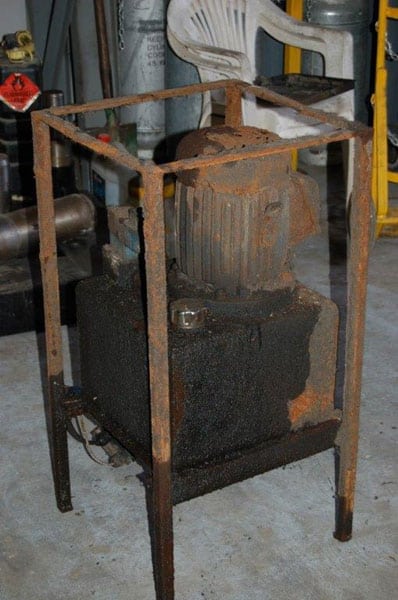
This the condition of the first dock loader power unit.
Pretty disgusting.
The second dock loader stopped working .
He engaged a Hose doctor. (W*****)
The hose doctor suggesting replacing all the hoses.
My client agreed to have all the hoses replaced,1 days’ work.
They turned on, and it did not work.
What now?
He rang us.
We were able to respond within the hour.
We looked at the system for 10 minutes; it was the easiest diagnostic problem ever.
We checked the power unit.
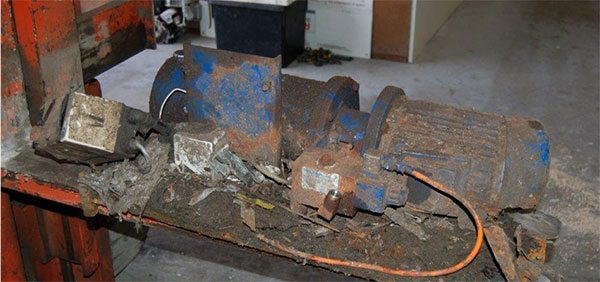
Look what we found.
Guess what?
The tank was rusted out.
There was a hole in the tank.
This is nursery rhyme stuff.
Remember the “There’s a hole in my bucket dear Lisa, dear Lisa, there a hole in my bucket”.
Only this bucket holds all the oil , and there was none left.
Why did the system not work,
As simple as falling off a log, NO OIL! 10 min work, that included signing in, and a hose w***** gave the advice to replace all the hoses!
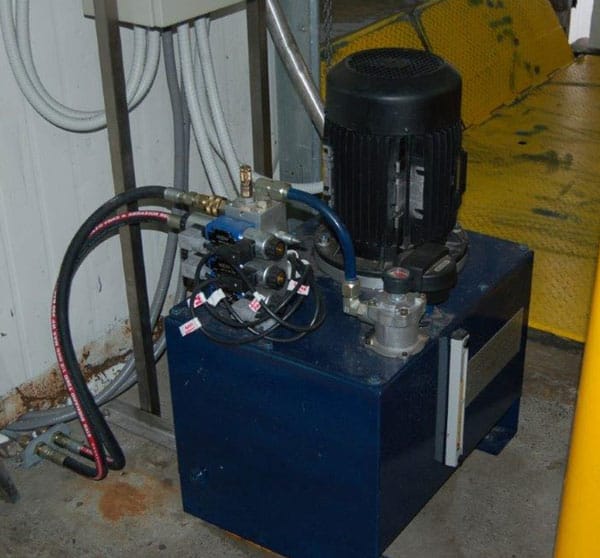
We installed and emergency hire power unit , and had them running, in 4 hours, both Dock Levelers.
Just because they had found the right repairer with the correct knowledge, training and equipment.
Two weeks later we installed a new system.
The only unanswered question, who is at fault ?
The Maintenance supervisor for not choosing the correct repairer? or the Hose W***** for giving unqualified advice and ripping the client off?
Nevertheless the plant was stopped for 36 hours.
The technician you choose determines the outcome!
Hydraulics deserve respect. They are powerful, precise, and essential to your operation. When something goes wrong, you need more than a hose changer — you need a trained hydraulic technician with the tools, knowledge, and experience to diagnose the real problem.
Your machine, your safety, and your bottom line depend on it.
Some questions you should ask.
What trade are you? They need to have from a mechanical trade background.
Believe it or not, have come across a butcher, an upholstery, a baker (he wanted a change working in working hours, and thought the job would be easy) all working as hose doctors with no prior mechanical experience. I had a guy who had a small orange squeezing business at the age of 45 wanted a change in career and applied for a role as a hydraulic technician.) He thought he could give it ago.
Where did you study Fluid Power and for how long.?
If they can’t answer or do not recognize the term Fluid Power they are probably not the rite guys for you.
Do you carry a flow meter in your truck, and what flow and Pressure can it read?
There is only one correct answer ever! Yes, or possible, I have 2, as does my staff.
I have heard a pilfer of excuses.
- No, I just carry pressure gauges is the usual one.
- No I don’t carry one because they are too expensive.
- Why do I need one of those. Or I never need one.
- The excuses will go on and on.
- No Flow meter, time to take and another breath and ring someone else, FAST!
Before they come out, they should be asking you to get all the information about the machine that you can provide, most importantly a circuit diagram?
Depending on whether this is fixed plant or mobile plant with electrical controls they may explain that they may need an electrician to work with them simultaneously. This is a good thing.
The electrician should be one that understands controls and possibly PLC’s
By asking questions they may determine whether other specialized equipment not usually carried in the service truck can be loaded in, instead of wasting time on an initial visit, then having to return to the workshop.
They should ask if the operators will be there.
Normally clients will send the supervisor. As a technician we can learn meaningful information from both. It is important to let the operator speak for himself; they are often cut off by a supervisor. They are a valuable source of information. Keep in mind they would normally be the last person to see the machine actually working and are more familiar with the machine than most other people.
Hopefully your hydraulic technician will ask, is there any safety issues?
They should be asking you a bucket load of questions about the machine and your situation. It might seem like a waste of time, trust me if you get positive answers on these questions you are probably on a winner.
Not only are you interviewing the repairer, we are sounding you out to.
Potential clients on the phone that are in to much of a hurry to go through these questions, and just want to get the job done, can be perceived as potentially troublesome clients and may be hard to work with. This could affect any pricing offered or whether or not there are any service fitters available. It is truly a team event to get your job back working and you treat it like that, you will get a better result.
Your repairer is a real person to, and will not tolerate getting stuffed around. If they are good they will always be busy.